

How Consolidated Label Is Using BW Converting’s Baldwin Guardian PQV Inspection System
In the label industry, few honors carry more weight than the TLMI Eugene Singer Award for Management, which recognizes excellence in business performance through the association’s annual Management Ratio Study. Consolidated Label has earned that distinction more than any other company.
For a company with that kind of reputation for excellence, raising the bar on print inspection points to a broader reality in today’s market: printed packaging buyers are becoming far more selective. Even for a converter with a long track record of quality, meeting those expectations now requires a higher level of quality control precision.
Charles Mitchell, COO of Consolidated Label, explained, “We couldn’t just rely on the flexo operator anymore. We had cameras on different presses, but the eye and the quality sensitivity of the customer had changed. That’s really what drove us to add another level of inspection before those labels went out the door.”
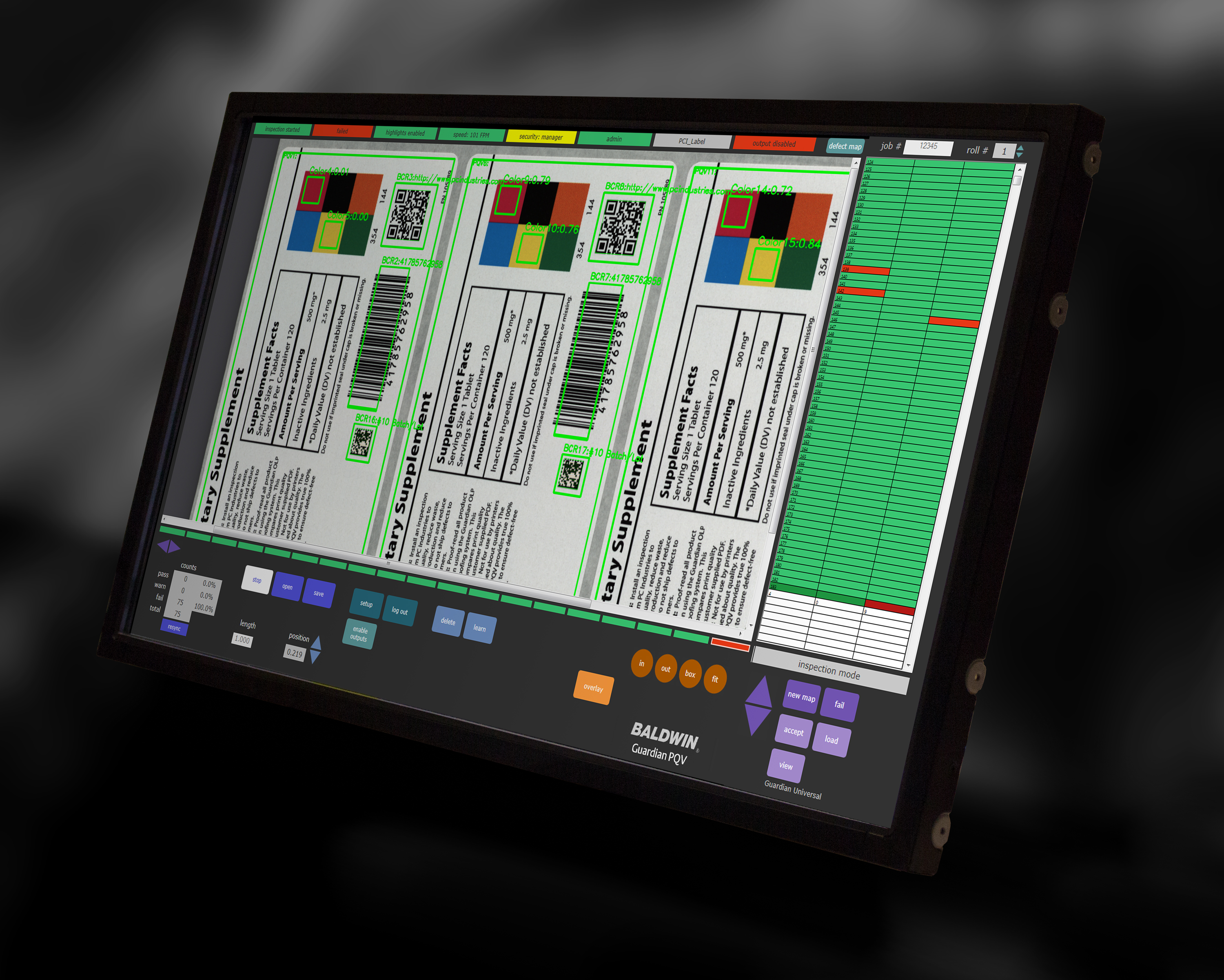 Since early 2024, Consolidated Label has purchased six Baldwin Guardian PQV inspection systems for the company’s slitter rewinders, with an additional system now being installed on a 22-inch Nilpeter press. The first phase of deployment focused on pharmaceutical and nutraceutical work, where tolerance for print imperfections is especially low and even minor defects can create outsized customer concerns.
Rather than immediately changing the company’s pressroom philosophy, Consolidated Label first placed the systems downstream on slitter/rewinders. That allowed the company to preserve flexo throughput while adding a higher level of inspection before the final product shipped.
Building inspection into the workflow
“At the time, we wanted to find the defects before they reached the customer, but we didn’t want to completely change the philosophy on the flexo side,” Mitchell said. “We drive our presses as fast as we can for speed and uptime, and then we relied on our slitter rewinders to give the product a higher level of inspection further downstream. The strobes on these systems just couldn’t catch some of the minutest imperfections. So we said, let’s stop the bleeding, let’s put the cameras on the slitter rewinders, and let’s make sure we’re catching those issues before they leave the plant.”
That strategy gave Consolidated Label time to learn the technology and tailor it to the realities of its operation. Over a period of months, the company refined settings based on actual customer requirements, material types, laminates, foils, and defect patterns. Mitchell said that process required an engineering commitment, not just an equipment purchase. “We spent time tailoring these systems to specific settings based on customer defects and what was coming through,” Mitchell said. “Every customer is different. Every material is different. Every laminate, every foil, every profile is different.”
That effort is paying off. Mitchell said customer complaint dollars have declined, while customer satisfaction has risen. “We are very bullish about the technology,” Mitchell said. “The biggest difference is that customer satisfaction has gone up, and we’re seeing customers return and say, ‘Wow, this is phenomenal stuff.’ That’s probably the biggest impact. It’s about delivering a higher degree of quality and having customers recognize that.”
Productivity gains and a shorter learning curve
The technology has also changed the productivity equation on the finishing side. Before Guardian PQV, speeds on the company's slitter rewinders were constrained by what an operator could realistically inspect with the human eye. With automated inspection in place, those limits shifted. Mitchell said Consolidated Label has nearly doubled speed on some slitter rewinder applications, moving from roughly 100-140 feet per minute into the 200, 300, and in some cases 400 feet per minute range.
Just as important, the systems have helped reduce dependence on operator judgment alone, which has implications for both training and workforce flexibility.
“Our operators love these systems,” Mitchell said. “This was a huge culture change for us. We have a fairly experienced workforce, and bringing in a technology like this was a big shift. But once people got comfortable with it, we started seeing the payoff. The speed of the machines is no longer dictated by the eyes of the operator. It’s dictated by how fast the camera can pick up the defects. And the learning curve of using a slitter rewinder comes down too. Instead of someone needing six or eight months to really understand a wide range of customers and products, we’re now closer to 90 days, because now the learning curve is just how to use the inspection system.”
That shorter learning curve matters in an industry where experienced talent remains difficult to find and retain. It also makes cross-training and production reallocation easier, since the same camera logic and documented process can be applied across multiple machines.
BW Converting: more than a technology supplier
For Mitchell, the value of the investment also includes the supplier relationship behind it. Consolidated Label evaluated multiple camera providers before choosing BW Converting, and he said that decision has been reinforced over time. “BW Converting is a great company to work with and they’re very responsive,” Mitchell said. “They’re a true partner, and I’m not done yet. I have other machines I’m going to put these systems on.”
Now, with six offline systems in place and another installation moving onto press, Consolidated Label is beginning to push inspection further upstream. That next step reflects confidence not only in the Guardian PQV platform itself, but in the process discipline the company has built around it.
For Mitchell, the takeaway for other converters is straightforward: let customer expectations and hard data guide the decision. “I would look first at customer criticality and at the rejects coming back from the customer,” he said. “Then I would look internally and ask, can we correct the process another way, or does it make more sense to automate this? If you have a customer base that needs that level of quality, and you’re seeing the data that says these kinds of defects are hurting you, then it makes sense. Let the data talk,and then make a decision.”

Under the banner of our industry-leading Baldwin Technology brand, BW Converting manufactures industrial enhancement technology and consumables for the printing, packaging, textile, film extrusion, EV battery and corrugated industries.

BW Converting designs and manufactures precision machinery for Tissue, Hygiene, Print, Packaging, Mailing, Textiles and other high-performance Industrial applications. We unify our product brands Paper Converting Machine Company (PCMC), Winkler+Dünnebier (W+D), Baldwin Technology Co., Hudson-Sharp, STAX Technologies, and Northern Engraving and Machine under one global organization.